Fiction | A Mountain Tale
Fantasma de montes

On southwestern Negros where the mountains rise like molars from the mouth of the sea, there is a great, unhurried wedge of land ascending toward the peaks in a straight line as slowly as the sun rises, and to that slope the villagers of Lipayo had climbed at great ease to make a neighborhood of winding footpaths and quiet groves where each household rested in its own pool of shade. They did not know how perfect the place was, how their terraced glades had come to resemble a continuous hanging garden, or how this arrangement gave to each property its own sense of serene concealment, with just one neighbor or perhaps two looking down from a comfortable distance. From there he might look down and wave “Maayong hapoon!” at the top of his lungs and have even chances of catching someone’s notice.
It was well-known in those days that down in a great gutter between the village and the peaks, at the depth of the sea in a heavy, unchanging twilight where steam rose from a cascading brook, there lived an ogre of an aspect too terrible to look on without fainting. Everyone knew this because there were charcoal drawings of him on the wooden siding of their houses, and Jing-Jing the herbalist’s daughter had seen him once while relieving herself in a bush under the Moon. The tusks protruding from the corners of his mouth gleamed white and curved up at their tips like a gardener’s scythe. His lower teeth looked as sharp as thorns and curved inward like hooks. He had a gray beard that fell down to his chest and wore an animal’s fur around his loins. But the most terrible features were his eyes, how they stared wide-open and gleaming black, unblinking, as though they could make no other expression. That was why Jing-Jing always drew him that way. She was also careful to show in the finest detail of which she was capable the massive club he always carried slung over his shoulder, its handle carved down to the girth of a sapling so he might grasp it, and its head driven through with spikes of iron that he forged in the hot places far below in the lee of the mountains.

Noticing a drawing for the first time, a woman stopped and looked it over with a little smile and suddenly turned away. There was a common feeling that such a creature, once drawn and spoken of, might really be out in the forest. It didn’t help the village’s general trepidation that Jing-Jing seemed to know all about the ogre, its diet, its grooming, its comings and goings, and even the size of its balls, which she compared to marang fruits because she had spied them while he lay supine under the Moon, drunk on the coconut wine he had looted from a bamboo portico. This last made an old man chortle then look very serious. For which among his kin could he depend upon for help in countering such a monster when it came crashing out of the trees? Such unexpected questions always came up at the mention of the ogre. The thing required a measure of anxious thought beyond the customary.
One night, an enormous din disturbed the village at midnight and snatched everyone from the deepest sleep. Almost at the same moment, the village bell, a loop of flat iron hanging from a low branch, was heard clanging in a most alarming frenzy as though the one sounding it were in convulsions. The combined effect was enough to bring man, woman, and child out to the square under the chieftain’s house, and as it sat on the loftiest pilings, some of the women went under the house like anxious hens.
Many of the men were grasping their spears and standing in a provisional wall around the heterogenous hubbub in the middle where screams and chattering and even some laughter reigned.
“Can any of you explain what is happening?” the chief’s voice rattled from above their heads. A cry and a wailing were heard amid the warm tangle of arms and legs. The throng watched as Jing’s parents, doubled over in grief, climbed up to the chieftain’s porch to confer with him. As he listened, they saw his constricted face open up into broad amazement. Then, suddenly spry as a child, he climbed down the ladder and ran headlong in the direction of the bereaved house. The whole village followed in a whirling procession like a school of sardines. There were shouts of declaration and contention when they found that a whole corner of Jing’s home had been hammered to smithereens, leaving a gaping void as yet clouded with the dust of destruction and motes of fluttering thatch. Jing was gone, the parents wailed, and the ogre had broken her out like one breaking the meat out of a shellfish. The ogre had made a meal of her!
It could not have been otherwise, for she was the very girl who had been foolhardy enough to spread his lore all around the village until they were all less inclined than ever to venture out after dark. (It was a feature of those islands, in acknowledgement of powers beyond muscle, bone, and iron, that even the bravest men stayed in their houses at night.)
But on that night a hue was raised and a fire was lit in the square, and men carried torches into the darkness to look for the tracks of the ogre. (For these were the days when men were broad of chest one and all, in proportion if not in size.) They went down cavernous gorges and up along ridges so treacherous a man could fall and never be seen again. The tops of mighty trees below them looked as humble as greens for eating, yet, as the sun climbed, other trees towering above them colored them in a bronzen twilight.
At length the troupe ascended through a purple mist, and for those among them still boys, it was the first adventure they had undertaken; they too were stout of heart and carried daggers or sharpened sticks. They pursued the leading men up into the clouds through a dolorous and wending climb until they all reached a broad, level field in the sky.
It was a strange place. A little rampart of tumbling stones embraced the flatland all around. In the center stood a pool of water as square as the work of a mason, with steps leading down and clear, still waters reflecting the verdant mosses on the stones. They conferred softly with each other, some saying that here was the greatest danger they had met, and they had better turn back, others imputing ownership of the pool to the fiend, and they might await him here in ambush.
It was well that none of them dared enter the water, for as they waited on its paved lip the water filled with light like an emerald in the sun, and a lady rose out of the water. Black hair covered a cheek as white as a seashell, and the wide wings following behind her seemed to be woven out of the beams of a rainbow. Her fair, unblemished body was all bare, except that an invisible garment obscured her secret parts. The chief looked on her astonished and forgot to breathe when she spread her wings in a display of brilliant colors.
Out of the water behind the great fairy came three girls much smaller than her, and the color of leche flan, but arrayed in gowns as bright and dazzling as the fairy’s wings. One of these girls looked around her in pleasant recognition and went straight to kneel at the feet of the chief, for she was Jing, the girl so recently stolen.
The fairy’s wings flickered and faded down to nothing, like twin flames quenched by rain, as she advanced through the host to meet the chief, and the men all pressed hard around as her light dimmed down to but a pearly complexion. And she knew them all by name, for she said: “Well met, Makati, chief of your people. What brings you here to these heights and my Pool of Stars? Or who called you here?”
Knowing he must answer, the chief said, “An ogre as big as six men crushed a house where I live and stole away with one of our daughters. That is why I came, and with no other purpose.”
“You’re telling me the truth, for your daughter lies at your feet,” she said. “The ogre is called Galan; he loves me without measure, and thinks he will win my gratitude if he brings any young girls to this place from the hills below. At any rate, his offerings call me forth that he might see me, and I take them into my keeping and clothe them and bring them with me to feast and play.”
“What is down there under the pool?” asked the chief.
“The pool is like all the waters in the world,” she replied, but the chief only stared. So the lady said, “The other girls I return to you.” The men searched the face of the second girl, and she was Mimi, vanished five years ago, and the third was Alina, missing for ten. The men marveled that all were as young and innocent as the day they went missing. At this, the men rejoiced, and some sang songs, and some danced a merry dance.
“Now go,” said the fairy, “and I will tell you what to do. Go forth, and let the girls follow behind. When the ogre appears to give chase, the brilliance of the girls and their raiment will charm him and he will follow closely like one lost in a dream.”
Then with her feet in the water, and the wings rising out of her back like twin moons, the fairy grew back into all her brilliance and bade them good-bye.
Just as the fairy had told them, the ogre accosted them on their way down the treacherous heights, and bellowed and roared. His black lips were ever bared to show the blades of his teeth. The liquefaction of corpses oozed from the corners of a mouth like a den of sea-urchins. He came so close that his shoulders and arms overhung them like the timbers of a mighty gate, and his beard was a chaos of gray vines growing alongside the groaning tree-trunk of his body. The crashing and cracking of his arrival terrified the men; only their chief Makati remembered what the fairy had said and told them to part, revealing the girls in their gowns of colorful radiance.
Slavering and gaping, the ogre was stunned, and the men passed between the pillars of his arms and legs like children passing under a bridge. Down the ridges they went, and clambered through lightless gullies, with the ogre stamping and moaning behind the girls—Alina, Mimi, and Jing.
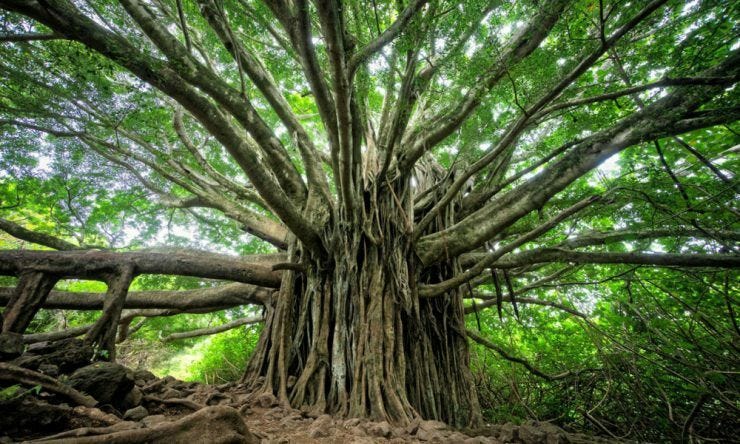
When at length they came down to the village on the wedge of land above the sea, it seemed best to leave the girls encamped nearby beneath the wide umbrella of a Balete tree, and to that spot their parents came rejoicing to bring them food and have their fill of talk.
This was their state for many weeks: the girls resting on the bluff over the village, shining at night like lanterns of rainbow-light in the blackness, with the ogre squatting close by, as dumb and immobile as a hairy boulder.
It was a troubled peace, for anon their parents wondered when Jing, Mimi and Alina might return to the village and resume their family dwellings. Instead the girls presided over the high place like a trio of oracles, watched and visited constantly by the women, that they might hear time and again everything pertaining to the fairy goddess and the Pool of Stars.
Just as the sight of their daughters on the hill, however glorious, began to pall in the eyes of their parents, the fighting men also grew irked by the ogre sitting nearby, which though it never ate or drank or slept, kept a ceaseless vigil over the girls and was felt a menace if it should change its mood. “Our daughters are trapped until this smelly monster dies, but he seems only to grow in patience as he watches, his health advancing every day to new strength,” they said among themselves. And they marveled that the fairy goddess suffered the ogre to live. Was all the power of one who wore the rainbow insufficient to snuff him out? Then they could live as before.
But Jing was wilier than her companions. One night as the others slept, she crept out of the village, and the ogre followed her with gurgles in his throat. Jing went down a path to a precipice overlooking a bottomless river gorge. Spry as a monkey, she crawled far out along the trunk of a tree above the void. The ogre had an eye for nothing but her luminous garments: he went on following until he crashed by stages from branch to branch, loud crackles fading to distant whispers, all the way down until he was smashed to pieces on the pointy rocks far below. And no villagers were there to scream at the sight of Jing’s perch being split in two by a thrashing arm of the ogre’s, or her silent, steady flight like a dying spark going down into the blackness.
When the village awoke and found Jing and the ogre were missing, it seemed to them that Jing had wearied of her place and run away, the ogre giving chase, and they soon despaired of her return. Afterward, there was celebration at the return of Mimi and Alina to their houses, but a vigil of mourning at the house of Jing.
Many days later came the ascension day of Chief Makati, and while the people danced and lit fires and feasted on roasted pigs, the fairy suddenly appeared in their midst holding another woman by the hand, who was also dressed in the rainbow colors and had wings on her back.
“What is the matter now?” asked Chief Makati.
“I return your daughter to you, Jing, the greatest of all your girls.”
Their eyes were opened, and they saw that the second fairy, who had familiar eyes and a well-known smile, was Jing the mischievous girl, but grown into fairy womanhood. They were all glad of her return and the aunties were already commenting to each other: Which of the men would such a gorgeous creature marry? Our village has no gods among its sons, but quite a few devils! But what was between her legs now that she was half-butterfly? A pair of jaws! Their laughter was deafening.
Then the chief addressed the elder fairy: “We marvel that you permitted all of this to happen.”
The fairy answered saying: “That ogre was once my brother, and I dared not kill family.”
“Still, we marvel that you permitted him to take away our girls, or that it seemed right to you that he sat among us and oppressed us and would never leave.”
“Be that as it may,” the fairy replied, “it would have been a sin to do anything to him or say thus and such about his evils to an authority, inasmuch as he was my brother.”
“You might have locked him away,” said Makati.
“That would likewise be a sin,” said the fairy. “His sorrowful imprisonment would have ripped my heart in two.”
The chief regarded her a long time and then assented coolly to all that she had said. “Nevertheless, it is no hardship to you to see him gone.”
And the fairy granted this much with a subtle smile.
Great happiness followed, and Mimi and Alina were put up with husbands in the highest houses, living like princesses, and Jing lived in a house constructed in the Balete tree without a stair or ladder, so she could fly to it for privacy, and at her pleasure alight among the talkative aunties, for she loved to hear all that they would say to her.